

The traditional florentine football game
The traditional florentine football game.
The 24th June 1930 was the fourth centenary from Francesco Ferrucci's death, the valorous knight who defended Florentine Republic during the siege of Florence of 1530.
The 17th February 1530 Florentine population played the traditional football game (calcio in costume) in Piazza S. Croce to react against the troups od Charles V: soldiers were relaxing because the war was lasting for several months!
A group of musicians stayed on the roof of the church of S. Croce to show the enemy they had no fear; luckily a cannon shot didn't hit them!
The football game was held another time from 1930 in a different scenary; Piazza Signoria. This event had a lot of success. Florence was proud to commemorate its origins, for this reason a match was played each year on St. John's day (24th June) until the second world war to feast the patron saint of the city.
Four teams represent with their colours the quartiers of the city; Blue S.Croce; White S. Spirito; Green S. John; Red S. Maria Novella. The rectangular square of S Croce is divided in two parts, it is covered with sand and sorrounded by metal fences. The two goal posts are situated on the shorter sides. The match is long 50 minutes and there are 27 players for each team. They can catch the ball with their hands, feet, heads and the aim is to make a "caccia", that is a goal. Each "caccia" corresponds to a point: in fact after a "caccia" the ball is positioned in the centre of the square to start again. If the goal fails the team lose an half point (metà caccia). At the end of the match the Florentine population answers "Viva Fiorenza" to the exhortation of the captain of the district who says; "Shout with me, Florence hurrah!". The winner team, the one with more goals, symbolically receives a white veal.
S. John the Baptist is arriving and the final is In a few days: white against red: S. Spirito against S. Maria Novella! Who is going yo win?

The "colubrina", a small cannon, shoots each time a team makes a "caccia" and at the end of the match.
Altri articoli
Do you know a secret passage?
In 1877 the secret passage was accessible: four thousands and five hundreds of people crossed it paying twenty-five cents each one!
A XVII century giant in a secret garden
The monster imprisoned Ulysses and his friends in a grotto to eat them.
Vincenzo Viviani and his Master Galileo Galilei
On the facade of a florentine palace called "Palazzo dei Cartelloni" ("cartellone" in Italian means "poster") situated near the central station.
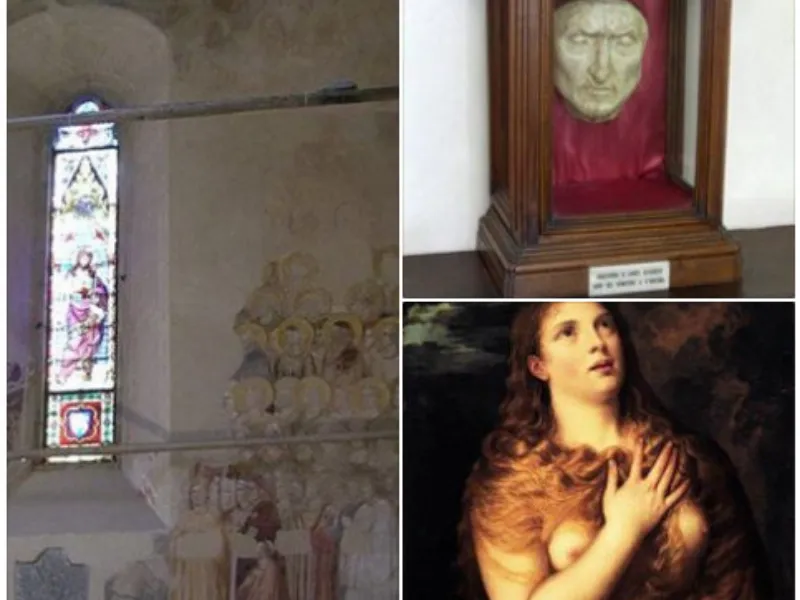
The Chapel of Mary Magdalene
In the same period Seymour Kirkup, the historian who financed works in the chapel of Mary Magdalene, was the owner of Dante's mask now preserved inside Palazzo Vecchio.